

It all started with a simple question, regularly asked by our guests: “Can we taste the Château’s wine?”
And unfortunately, we always gave the same answer: “No!” because it no longer exists… This shared nostalgia gave rise to the idea of recreating a wine in our image: a light, honest and convivial wine, the opposite of the rigid codes of traditional Bordeaux.
An aperitif wine, to open without a second thought and share with friends when you want to drink something other than rosé or white wine.
La Source de la Fontaine is our answer to an expectation: a light red, to be drunk (very) chilled, easy to enjoy, designed for those who love wine but not necessarily the ceremony that surrounds it.
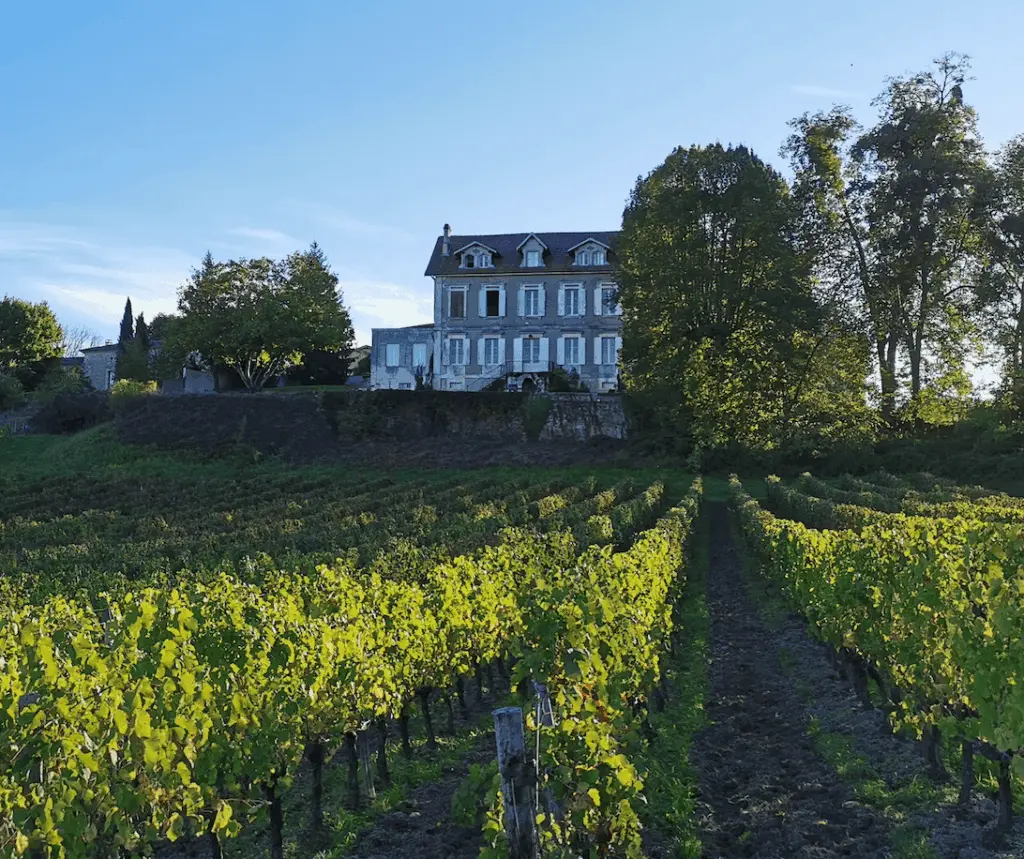
To create it, we teamed up with winemaker friends in the Fronsadais, a region where a warm welcome defies preconceptions.
Together, we crafted a distinctive wine, made mainly with Cabernet Franc, a grape variety usually used as a complement but here fully embraced. The blend for the vintage is thus 80% Cabernet Franc and 20% Petit Verdot.
The result: a lively, supple and joyful cuvée, far from the stiff bottles that are kept “for special occasions”. It is a wine that is true to and proud of its Fronsac roots in the Gironde, yet free of the “Bordeaux” label. A wine that invites discovery, conversation and, above all, immediate pleasure.
La Source de la Fontaine is a living wine, rooted in nature. It follows an environmentally respectful approach: the wine is organic, made from grapes grown without pesticides or synthetic chemical fertilisers, thus promoting biodiversity and soil health.
But we chose to go further by turning to biodynamics, an approach that regards the vineyard as a living organism, in harmony with natural cycles. Biodynamics involves the use of natural preparations made from plants and minerals, and respect for a lunar calendar for work in the vines.
Above all, the principle of biodynamics aims to put as few products as possible in the wine (even organic ones), giving us the wine we were looking for: a lighter, suppler and more digestible wine.
To put it another way, and plainly: a thirst-quenching, easy-drinking wine whose possible excesses you don’t regret the next day!
The best way to discover La Source de la Fontaine is of course with us, at Château La Fontaine, in a warm and convivial setting.
During a stay, an event or simply an aperitif on the terrace, we love to let people taste this wine the way you share a good time with friends.
For those who would like to extend the experience at home, the cuvée is available to buy directly on site, or to order by emailing nicolas@marette.me
We favour short-circuit distribution, in direct contact with wine lovers who, like us, are looking for authenticity and simplicity.
La Source de la Fontaine is the red wine of Château La Fontaine, blended by Émilie and Nicolas with a partner winemaker in Fronsac. It combines 80% Cabernet Franc and 20% Petit Verdot, far from the classic Merlot-led Bordeaux blend. It is a light, fruity wine, best served chilled as an aperitif.
Cabernet Franc brings freshness and fruit, while Petit Verdot adds colour and structure: two historic Bordeaux grape varieties that are rarely blended on their own. Château La Fontaine chose them for an easy-drinking, cheerful, unpretentious wine. It is meant to be enjoyed young, with friends.
La Source de la Fontaine comes from vines grown according to organic and biodynamic farming principles, and is blended by Émilie and Nicolas with a partner winemaker.
Yes, La Source de la Fontaine is sold at the estate (just get in touch with us) and at the La Fabrique Made in Fronsac shop. Guests can also taste it during their stay. More details on the Our wine page.
From Fronsac, ten Right Bank appellations are less than 30 minutes away: Fronsac, Canon-Fronsac, Pomerol, Lalande-de-Pomerol, Saint-Émilion, Saint-Émilion Grand Cru and the Saint-Émilion satellites (Montagne, Lussac, Puisseguin, Saint-Georges). Their wines are mostly Merlot-based. Fronsac and Canon-Fronsac remain the least known and offer excellent value for money.
The châteaux of Fronsac and Canon-Fronsac, a few minutes from Château La Fontaine, are generally easier to visit than the Saint-Émilion grands crus, which are often booked weeks ahead in summer. The Pomerol open days, in November, also give access to estates that are usually closed to visitors. Read our guide to the Pomerol open days.